Population of Chad: demography, major cities, languages and migration
What does the population of Chad represent?
The population of Chad is about 19 million in 2025 according to the International Monetary Fund, spread over 1,284,000 km² in the heart of the Sahel. This landlocked Central African country brings together a great diversity of languages and ethnic groups, and now hosts more than a million refugees from Sudan.
An old census and diverging estimates
The last general census of Chad dates from 2009. A third operation is being prepared, with a mapping phase launched in 2025. In the absence of recent results, current figures rely on projections.
These projections do not coincide. The IMF uses 19.0 million inhabitants in 2025, whereas the United Nations, in its 2024 world population prospects, puts the figure at 21 million for the same year. Neither figure replaces a headcount: the real population remains known with a margin of uncertainty.
Cities and distribution of the population of Chad
N'Djamena, the capital, lies at the confluence of the Chari and the Logone, on the border with Cameroon. It concentrates the administration, the main markets and most of the urban population.
In the south, which is rainier and more heavily cultivated, Moundou, Sarh and Kélo are agricultural and commercial centres, linked in particular to cotton. In the east, Abéché, the former capital of Ouaddaï, structures trade with Sudan. The desert north of the Sahara, in Borkou, Ennedi and Tibesti, remains very sparsely populated, whereas the Sahelian belt in the centre is home to mobile herders who follow the pastures through the seasons.
Languages and ethnic groups
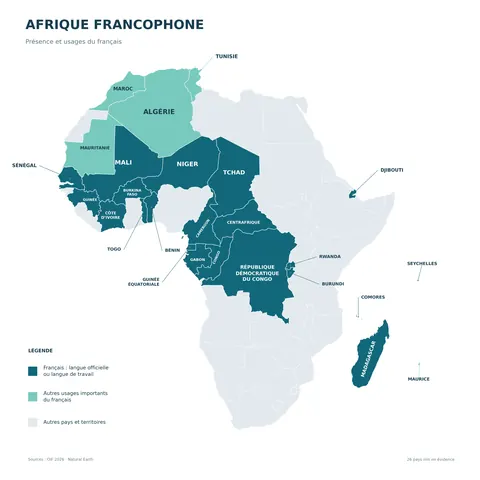
French and Arabic are the official languages of the country. French is used mainly in administration and higher education, while Chadian Arabic serves as a lingua franca between communities across a large part of the territory.
The country has more than one hundred and thirty languages, according to estimates. The 1993 census placed the Sara first with 27.7% of the population, followed by the Arabs with 12.3% and the Mayo-Kebbi groups with 11.5%. The Sara live mainly in the south, and the Kanem-Bornou groups around Lake Chad.
Refugees, displacement and migration
Since the start of the war in Sudan in 2023, Chad has become one of the main host countries on the continent. According to UNHCR and the World Food Programme, in April 2026 it hosts about 1.3 million Sudanese refugees, of whom more than 900,000 arrived since 2023, which is one person in thirteen in the country and one in three in the east.
More than 243,000 people remained stranded in the eastern border areas, for lack of funding to relocate them. The Chadian authorities keep their borders open, but humanitarian aid is lacking: UNHCR assists only four refugees in ten and rations have been halved for most of them.
Other movements add to this influx: internal displacement linked to armed violence around Lake Chad, seasonal migration of herders between the Chadian Sahel and neighbouring countries, and a rural exodus towards N'Djamena and the towns of the south.