The population of Ivory Coast: demographics and settlement
The population of Ivory Coast: size and definition
The population of Ivory Coast (Côte d'Ivoire) stands at 29,389,150 resident inhabitants according to the 2021 general census of population and housing. It is young, mostly urban and highly concentrated around Abidjan, the great metropolis of the Gulf of Guinea. Non-Ivorians make up 22% of it, a share that reflects the long history of regional migration.
A young and dynamic demographic profile
The 2021 census measures an average annual growth rate of 2.9% between 1998 and 2021. The pace is slowing: it stood at 3.3% between 1988 and 1998, and 3.8% between 1975 and 1988. National density is 91.1 inhabitants per square kilometre, against 48 in 1998, nearly double in twenty-three years.
The age structure remains very young: 75.6% of inhabitants are under 35. The dependency ratio falls to 69.2%, against 83% in 1998. Men make up 52.2% of residents and women 47.8%, a masculinity ratio of 109 men for every 100 women. The International Monetary Fund estimates the population at 32.9 million inhabitants in 2025, an estimate that exceeds the 2021 census figure.
Cities and urban distribution
In 2021, 52.5% of inhabitants live in towns and cities, or 15,428,957 people, against 47.5% in rural areas. The Autonomous District of Abidjan holds 21.5% of the total population and 36% of the country's urban residents. Bouaké accounts for 4.7% of the urban population, and seventeen cities exceed 100,000 inhabitants.
The demographic weight of the regions ranges from 0.5% for the Folon region, in the north-west, to 21.5% for the Autonomous District of Abidjan. Yamoussoukro is the political capital, while Abidjan remains the economic centre and the country's main pole of attraction.
Languages, peoples and religions
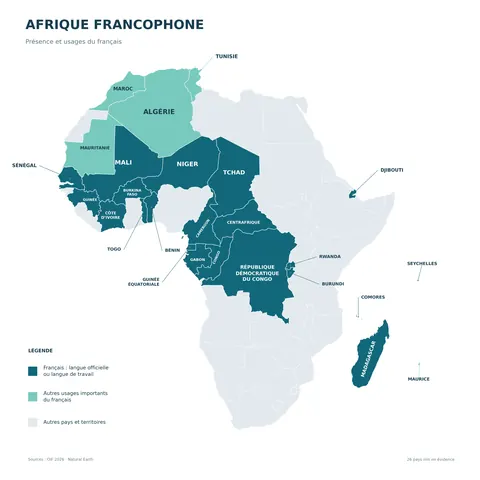
French is the official language. It coexists with many national languages, among them Baoulé, of the Akan family, and Dioula, the trade lingua franca across a large part of the country.
Among Ivorians, the 2021 census distinguishes five main groups: the Akan (38.0%), the Gour (22.0%), the Northern Mandé (22.0%), the Krou (9.1%) and the Southern Mandé (8.6%). According to the same census, Islam accounts for 42.5% of people and Christianity for 39.8%, while 12.6% declare no religion and 2.2% are animist.
Migration and the foreign share in the population of Ivory Coast
The 2021 census counts 6,435,835 non-Ivorians, or 22% of residents, against 33% in 1975. This share falls markedly over nearly half a century. Most foreigners come from neighbouring ECOWAS countries, in an area where the free movement of persons is recognised.
The country has long been a land of immigration, driven by cocoa and coffee plantations and the rise of Abidjan. Urbanisation, which places more than half of inhabitants in towns and cities, also draws rural people towards the large urban areas of the south.