Population of Cameroon: demographics, major cities and migration
What does the population of Cameroon cover?
The population of Cameroon stands at about 29.9 million inhabitants in 2025 according to UN estimates, spread across ten regions between the Gulf of Guinea and Lake Chad. The country is young, increasingly urban and multilingual, with French and English as official languages. A fourth census, the first since 2005, was launched in April 2026.
Demographics: a young and fast-growing population
The World Bank puts the population at 28.37 million inhabitants in 2023, and UN demographic projections raise it to 29.9 million in 2025. These figures differ according to the source and the reference year. According to the UN, the median age is 18.2 years in 2026, fertility is 4.1 children per woman and annual growth is close to 2.5%, for a density of 65 inhabitants per square kilometre.
The fourth general population and housing census, carried out together with the agricultural census, began on 24 April 2026. The collection, initially planned for 35 days, was extended twice, until 15 September 2026. The final results have not yet been published; the last count dates from 2005.
Major cities and urbanisation
According to the UN, 59.8% of inhabitants live in cities in 2026, or about 18.3 million people. Yaoundé, the political capital in the Centre region, has nearly 5.1 million inhabitants according to UN estimates for 2025. Douala, the economic capital and a major port on the Wouri estuary, has about 4.1 million.
Garoua, in the North, ranks third with about 679,000 inhabitants according to the same estimate. Bafoussam, Bamenda, Maroua and Ngaoundéré structure the other population centres, while the Atlantic coast, the West and the Centre hold the highest densities.
Languages spoken by the population
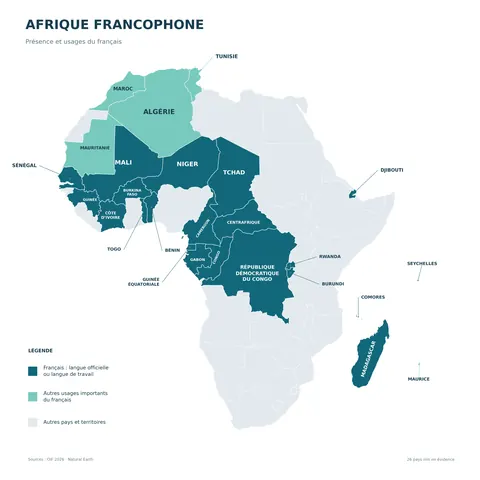
The Constitution makes French and English the two official languages, with equal status. Eight regions are mainly French-speaking; the North-West and South-West are English-speaking. Ethnologue lists about 280 living languages in the country, making it one of the most diverse territories on the continent.
Among the national languages, Fulfulde serves as a lingua franca in the North, Ewondo dominates in the Centre and South, Duala on the coast and the Bamileke languages in the West. Pidgin English is widely used in the English-speaking regions and in the large cities, where official bilingualism mixes with these everyday uses.
Migration, refugees and displaced people
Cameroon hosts refugees coming mainly from the Central African Republic and Nigeria. The United Nations High Commissioner for Refugees counts 415,282 refugees and 3,882 asylum-seekers on 31 October 2026, and 2,214,263 forcibly displaced people in total, including internally displaced people and returnees.
Internal crises also weigh on population movements: about 493,000 internally displaced people in the North-West and South-West according to the Office for the Coordination of Humanitarian Affairs, and about 511,000 in the Far North according to the International Organization for Migration. Added to these displacements are the rural exodus towards Douala and Yaoundé and emigration to Europe and North America.