Population of Gabon: demographics, cities and languages
How large is the population of Gabon?
The population of Gabon stands at 3,518,621 inhabitants according to the 2026 general census of population and housing, validated by the Constitutional Court on 27 August 2026 and carried out across the whole country. This Central African country, crossed by the equator and largely covered by forest, remains very sparsely populated for its size.
Two censuses, a population that has almost doubled
The 2013 census counted 1,811,079 inhabitants. The 2026 census, whose data collection was fully digitised and geolocated, records 3,518,621, an increase of about 94% in thirteen years. This result is well above earlier projections, which has prompted calls for clarification on the method and on the detailed breakdown by age, sex and province.
The figure covers all residents, whatever their nationality. According to the Ministry of Planning, about 2.32 million residents are Gabonese and about 1.2 million are foreign nationals.
Libreville, Port-Gentil and very strong urbanisation
According to the World Bank, about 80% of inhabitants live in towns and cities, and Libreville and Port-Gentil together account for nearly 59% of the population. The Estuaire province, where the capital is located, holds about 62% of residents on its own, according to the census results.
Libreville is the political and administrative capital, set on the Komo estuary. Port-Gentil, a port in Ogooué-Maritime, is the main centre of the oil industry. Franceville, in Haut-Ogooué, Moanda, a manganese mining centre, Oyem, in Woleu-Ntem, and Lambaréné, on the Ogooué, structure the interior. The other provinces, which complete the nine in the country, remain far less densely populated than the Estuaire.
Languages spoken in Gabon
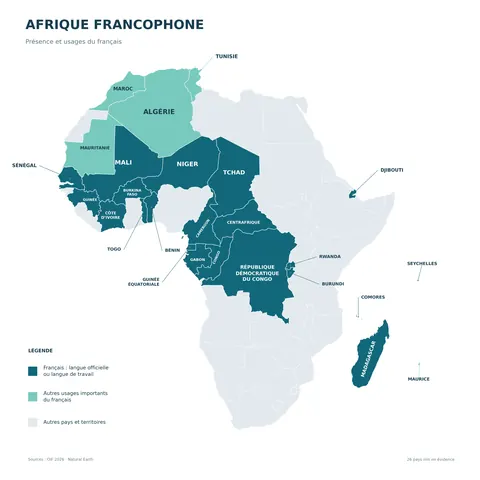
The Constitution of December 2024 adopts French as the official working language and tasks the State with protecting, promoting and teaching the national languages. French is used in administration, schools, the media and exchanges between communities, and it is the everyday language of many residents of Libreville.
The national languages almost all belong to the Bantu family. Fang, Myene, Nzebi, Punu, Teke and Kota are among the most widespread, each linked to a group of peoples and regions. The Constitution also requires every candidate for the presidency of the Republic to speak at least one national language.
Migration: a country of destination and transit
Gabon presents itself as a country of transit and destination in Central Africa, attracting migrants through its oil, mining, forestry and trading activities. At the second International Migration Review Forum, held at United Nations headquarters in New York on 7 and 8 May 2026, the Minister of the Interior stated that 387,637 foreign nationals had been regularised between 2022 and 2025 and that nearly 300,000 entry visas had been issued.
The country has reaffirmed its commitment to the Global Compact for Safe, Orderly and Regular Migration. It also organises assisted voluntary returns, 86% financed from the State budget, and it complains of insufficient cooperation from some countries of origin.