French-speaking African countries by sub-region and by status
French-speaking African countries: the criteria used
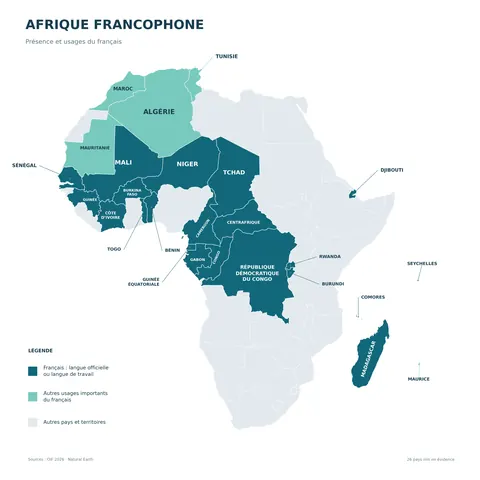
French-speaking African countries are the African states where French is an official, co-official or working language, together with those where it remains a language in everyday use in administration, education or the media. Twenty-one states fall into the first category and five into the second, making twenty-six countries across four sub-regions.
Four criteria for classifying the countries
The first criterion is constitutional status. French is the sole official language in Benin, Ivory Coast (Côte d'Ivoire), the Republic of the Congo, the Democratic Republic of the Congo, Gabon, Senegal and Togo. It is co-official with one or more languages in Burundi, Cameroon, the Central African Republic, the Comoros, Djibouti, Guinea, Equatorial Guinea, Madagascar, Rwanda, Seychelles and Chad.
The second criterion is working-language status. Mali since the 2023 Constitution, Burkina Faso since the revision of December 2023 and Niger since the charter of the refoundation of 26 March 2025 have kept French as a working language, while giving first place to their national languages.
The third criterion is use without official status. Algeria, Morocco, Mauritania and Tunisia have Arabic as their official language, with Amazigh in Algeria and Morocco, but French is used in higher education, business and the press. Mauritius has English as its administrative language, with French widely used in the media and in daily life.
The fourth criterion is membership of the International Organisation of La Francophonie. It does not coincide with the first three: Mali, Burkina Faso and Niger left it in 2025 while keeping French as a working language.
French-speaking African countries by sub-region
In West Africa, the countries are Benin, Burkina Faso, Ivory Coast, Guinea, Mali, Niger, Senegal and Togo. Guinea-Bissau and Mauritania are neighbours but do not belong to the official group: the former is Lusophone, the latter has Arabic as its official language.
In Central Africa, French is official in Cameroon, the Central African Republic, the Republic of the Congo, Gabon, Equatorial Guinea, the Democratic Republic of the Congo and Chad. Equatorial Guinea has three official languages: Spanish, French and Portuguese.
In the Great Lakes region and the Indian Ocean, there are Burundi, Rwanda, Madagascar, the Comoros and Seychelles, together with Mauritius for use. Djibouti, in the Horn of Africa, completes the group with French and Arabic as official languages.
Recent changes in the status of French
The status of French has been changing in recent years. Rwanda has placed it among four official languages alongside Kinyarwanda, English and Swahili. In Madagascar, the 2010 Constitution sets Malagasy as the national language and Malagasy and French as the official languages.
In the Sahelian countries, national languages now come before French in the texts. In Niger, Hausa is the national language; in Mali, thirteen national languages are recognised as official; in Burkina Faso, the national languages are official and French and English serve as working languages.
Table of French-speaking African countries
| Country | Capital | Status of French | Currency |
|---|---|---|---|
| Benin | Porto-Novo | official language | West African CFA franc (XOF) |
| Burkina Faso | Ouagadougou | working language since the 2023 revision | West African CFA franc (XOF) |
| Burundi | Gitega (political capital) | co-official with Kirundi and English | Burundian franc (BIF) |
| Cameroon | Yaoundé | co-official with English | Central African CFA franc (XAF) |
| Central African Republic | Bangui | co-official with Sango | Central African CFA franc (XAF) |
| Comoros | Moroni | co-official with Comorian and Arabic | Comorian franc (KMF) |
| Republic of the Congo | Brazzaville | official language | Central African CFA franc (XAF) |
| Democratic Republic of the Congo | Kinshasa | official language | Congolese franc (CDF) |
| Ivory Coast (Côte d'Ivoire) | Yamoussoukro (political capital) | official language | West African CFA franc (XOF) |
| Djibouti | Djibouti | co-official with Arabic | Djiboutian franc (DJF) |
| Gabon | Libreville | official language | Central African CFA franc (XAF) |
| Guinea | Conakry | co-official with the national languages (2025 Constitution) | Guinean franc (GNF) |
| Equatorial Guinea | Ciudad de la Paz (capital since January 2026) | co-official with Spanish and Portuguese | Central African CFA franc (XAF) |
| Madagascar | Antananarivo | co-official with Malagasy | ariary (MGA) |
| Mali | Bamako | working language since the 2023 Constitution | West African CFA franc (XOF) |
| Niger | Niamey | working language since the 2025 charter | West African CFA franc (XOF) |
| Rwanda | Kigali | co-official with Kinyarwanda, English and Swahili | Rwandan franc (RWF) |
| Senegal | Dakar | official language | West African CFA franc (XOF) |
| Seychelles | Victoria | co-official with Creole and English | Seychellois rupee (SCR) |
| Chad | N'Djamena | co-official with Arabic | Central African CFA franc (XAF) |
| Togo | Lomé | official language | West African CFA franc (XOF) |
| Algeria | Algiers | language in use, no official status | Algerian dinar (DZD) |
| Morocco | Rabat | language in use, no official status | Moroccan dirham (MAD) |
| Mauritania | Nouakchott | language in use, no official status | ouguiya (MRU) |
| Tunisia | Tunis | language in use, no official status | Tunisian dinar (TND) |
| Mauritius | Port Louis | language in use, no official status | Mauritian rupee (MUR) |