The economy of Guinea: growth, sectors, trade and investment
Economy of Guinea: a country of mineral resources
The economy of Guinea rests on mineral resources, in particular bauxite, gold and now the iron ore of Simandou, as well as on agriculture, which employs more than half of the workforce. The national currency is the Guinean franc, issued by the Central Bank of the Republic of Guinea.
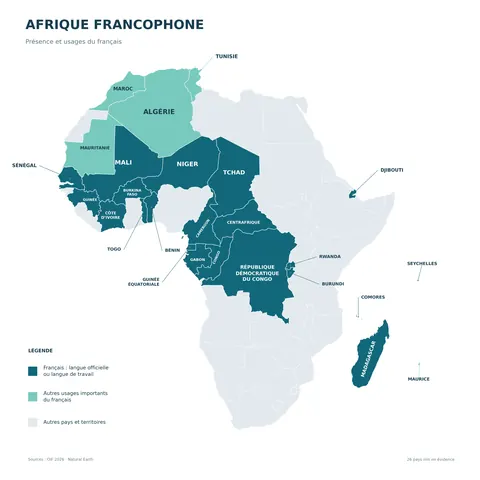
The country does not belong to the franc zone: the Guinean franc (GNF) is distinct from the CFA franc, used in West Africa by the eight WAEMU member states and in Central Africa by the member states of CEMAC.
Growth and basic balances
The World Bank estimates gross domestic product growth at more than 7% in 2025, against 5.4% in 2024, driven by the expansion of the mining sector in the country. This acceleration is explained by the start of production at new mining projects.
Inflation stood at 3.2% in 2025, against 5.1% in 2024. Access to electricity remains a constraint: it is close to 53% of the population, which limits industrialisation and the local processing of the country's products.
Sectors: mining, agriculture and energy
Its subsoil makes Guinea one of the major producers of bauxite, the ore from which aluminium is made. Bauxite exports rose by 31% year on year in the first half of 2025, according to the World Bank. Gold is mined notably in Upper Guinea, around Kankan.
Agriculture occupies 52% of the workforce and provides the income of 61.3% of the rural population, according to the World Bank. The country is nicknamed the water tower of West Africa because the Niger river rises there, and this hydraulic potential feeds energy projects.
Simandou and investment in the economy of Guinea
The Simandou iron deposit, in the south-east of the country, is a world-class iron ore deposit, with an iron content above 65%. Its first cargoes left the port of Moribaya from November 2025 for China, and the planned annual capacity reaches 120 million tonnes.
The project combines a mine, a railway line and a port facility. Rio Tinto, through Simfer, and the Chinese steel group Baowu are among the operators. Iron ore is thus added to bauxite and gold as the third mining pillar of the economy.
Foreign trade
Guinean exports rely largely on mining products, bauxite first, then gold and now iron ore. Shipments from Simandou direct a growing share of sales towards China, which is a major consumer of steel.
This dependence on raw materials exposes earnings to fluctuations in global market prices. The issues concern turning mining rents into formal jobs, wage employment remaining limited, and diversifying towards agriculture, light industry and services.