The population of the Central African Republic: demography, cities and migration
Population of the Central African Republic: the essentials of demography
The population of the Central African Republic stands at about 5.5 million in 2025, according to World Bank estimates. It is spread across a vast landlocked territory, mostly in the west, and most people live in small villages. The 2003 census remains the country's last complete survey, and a new count began in December 2025.
Demography: high fertility and social fragility
The World Bank reports a fertility rate of about six births per woman, which sustains rapid population growth. Around 67% of inhabitants live in extreme poverty, including 78% of rural residents and 51% of city dwellers. Nearly 40% of children under five suffer from chronic malnutrition, and the country ranks 191st out of 193 on the Human Development Index. According to the United Nations, around two million people, or 31% of the population, face acute food insecurity in 2026.
Cities, settlement and census
Bangui, on the banks of the Ubangi, is by far the largest urban area and is both the capital and a region. Carnot, Bouar, Bambari, Berbérati and Bimbo are among the other major towns, but Laval University estimates that two thirds of Central Africans live in small villages. The fourth general census of population and housing, after the 2003 one, was launched in December 2025 by the Central African Institute of Statistics and Economic and Social Studies. About 12,000 agents worked for eighteen days in 92 centres, 11 of them in Bangui, at a cost of more than 10 billion CFA francs financed by the State, the World Bank and the United Nations.
Languages spoken by the population of the Central African Republic
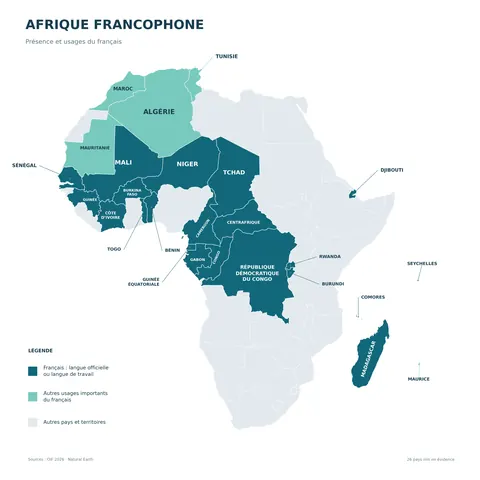
Sango is the national language and, with French, an official language under the first article of the Constitution. It serves as a lingua franca for almost all inhabitants and dominates in speech, while French prevails in writing, in administration and at school. About sixty local languages belong mainly to the Niger-Congo family. The Gbaya-Manza and the Banda together make up more than half of the population and live in the savannah. The Zande live in the north-east, the people along the Ubangi speak Sango, and the Babinga, the first inhabitants, live in the Lobaye forest.
Migration, displacement and refugees
At the end of 2025, UNHCR counts more than 738,200 Central African refugees and asylum seekers abroad: about 282,000 in Cameroon, 266,400 in the Democratic Republic of the Congo, 144,900 in Chad and 33,500 in the Republic of the Congo. Inside the country, 427,500 people are displaced at the end of 2025, compared with 469,900 a year earlier. The Central African Republic itself hosts about 53,600 refugees and asylum seekers, nearly 40,000 of whom fled Sudan since April 2023. Armed violence and the Sudanese conflict fuel these movements, particularly in the Vakaga prefecture.