Politics of Mali: the transition regime, Constitution and foreign relations
Definition: the politics of Mali today
The politics of Mali rests on a transition regime led by General Assimi Goïta, in power since the 2021 coup d'état. The legal framework combines the 2023 Constitution, which opens the Fourth Republic, and a transition charter revised in July 2025, which sets the length of the presidential mandate.
The Constitution and the organisation of powers
The Constitution was approved by referendum in 2023, with 96.91% of votes in favour and a turnout of 38%, results proclaimed by the Constitutional Court on 21 July 2023. It strengthens the role of the President of the Republic, who defines the policy of the nation, and provides for the creation of a second chamber, the Senate.
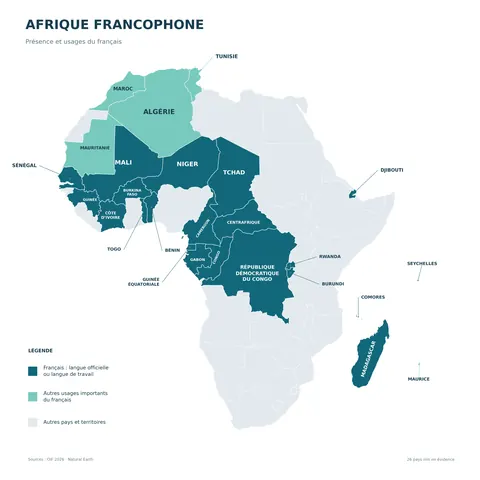
Article 31 makes the national languages the official languages and keeps French as the working language. The text also prohibits political nomadism: a member of parliament who changes group must resign and stand again before the voters.
Government, transition and electoral calendar
The Prime Minister is Abdoulaye Maïga, at the head of the government since November 2024. A partial reshuffle, announced on 12 February 2026, affected four of the twenty-eight portfolios. The National Transition Council acts as the legislative body and examines the state budget.
The same reshuffle raised three ministers to the rank of Minister of State: Sadio Camara for Defence, Alousséni Sanou for Economy and Finance, and Ismaël Wagué for Reconciliation, Peace and National Cohesion. Sadio Camara was killed on 25 April 2026 in coordinated attacks, and General Goïta himself took over the Defence portfolio on 4 May 2026. The Prime Minister's Office is preparing the government's action plan for 2027-2031.
The presidential elections planned for February 2022 were postponed several times, then adjourned without a date in September 2023 for technical reasons. In May 2025, the political parties were dissolved. In July 2025, a law granted General Goïta a five-year mandate, renewable as many times as necessary, without a prior election. No date has been set for a presidential vote.
Diplomacy: AES, ECOWAS and the Francophonie
Mali left the Economic Community of West African States, with the withdrawal taking effect on 29 January 2025, at the same time as Burkina Faso and Niger. The three countries form the Confederation of the Alliance of Sahel States, which has a common passport.
At the confederation's second summit, held in Bamako in December 2025, Captain Ibrahim Traoré took the rotating presidency for one year, and a unified force of 5,000 soldiers was launched. Mali nevertheless remains in the West African Economic and Monetary Union, whose currency it shares.
As regards the International Organisation of La Francophonie, Mali was suspended on 3 June 2021, then decided to withdraw from it, like Burkina Faso and Niger. The organisation's projects continue until completion for the benefit of civilian populations.