Guinean franc (GNF): Guinea's national currency, exchange rate and inflation
Guinean franc (GNF): definition of the national currency
The Guinean franc (GNF) is the national currency of Guinea, used only in that country. It is divided into 100 centimes, its symbol is FG and its ISO 4217 international code is GNF, with the number 324. It replaced the Guinean syli. The Central Bank of the Republic of Guinea (BCRG), based in Conakry, ensures the country's monetary and financial stability.
History of the Guinean franc and the syli
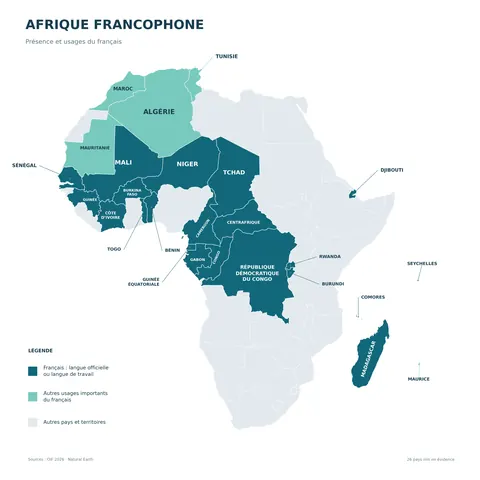
Guinea, independent since 1958, is not part of the CFA franc zone: it issues its own currency, unlike neighbours such as Senegal, Guinea-Bissau and Mali, which share the West African CFA franc. The Guinean franc was issued on 1 March 1960, on leaving the franc zone; the syli replaced it from 1972 until the mid-1980s, after which the Guinean franc returned. A series of banknotes dates from 1985.
The unit is worth very little: several thousand Guinean francs are needed for one euro or one dollar.
Issuance, monetary policy and exchange
The BCRG carries out its mission in four areas: monetary and exchange rate policy, supervision, financial stability and compliance. The Governor is Dr Karamo Kaba, assisted by two vice-governors, Elhadj Mohamed Lamine Conté and Almamy II Sylla. The bank's website displays the policy rate and the reserve requirement ratio, two instruments that govern credit and bank liquidity.
The central bank also publishes the exchange rates of the Guinean franc. Foreign exchange reserves reached 3.7 billion US dollars at the end of 2025, or 3.4 months of imports, then 4.5 billion in the first quarter of 2026, or 4.8 months of imports, according to the Governor of the BCRG. These reserves support the bank's capacity to meet the economy's foreign currency needs.
Inflation and growth: the Guinean franc and prices
In January 2026, inflation stood at 4.4% year on year, below the 5% threshold used in the ECOWAS area, according to the BCRG. Economic growth reached 6.6% in 2024 and 6.9% in 2025, according to the Governor of the central bank, when presenting the initial finance law for 2026 in March 2026.
In October 2026, the BCRG warned of inflationary risks and called for budgetary discipline, two conditions for the stability of the Guinean franc. A deficit financed by money creation fuels inflation, which in turn erodes the currency's purchasing power.
Regional framework of the Guinean currency
ECOWAS lifted Guinea's suspension on 28 January 2026. In that area, macroeconomic convergence covers inflation, debt and the public deficit, three criteria that depend on the monetary policy of each national central bank. Guinea keeps its own currency there, distinct from the CFA franc.