The population of Equatorial Guinea: demographics, provinces and cities
The population of Equatorial Guinea in figures
The population of Equatorial Guinea totals 1,668,768 inhabitants according to the 2024 estimate of the National Institute of Statistics (INEGE). The most recent census, in 2015, counted 1,225,377 people, or 44 inhabitants per square kilometre, of whom 76.1% lived in urban areas. The country comprises an island region and a mainland region.
Population growth and vital indicators
The censuses show rapid population growth: about 300,000 inhabitants in 1983, 595,995 in 1994, 1,014,999 in 2001, then 1,225,377 in 2015. Density rose from 11 to 44 inhabitants per square kilometre between 1983 and 2015. INEGE uses an annual growth rate of 3.4%.
The fertility rate stood at 5.1 children per woman in 2011 and the birth rate at 36 per thousand, against 43.2 per thousand in 2001. Life expectancy at birth was 59.5 years in 2015, or 58.4 years for men and 59.6 years for women. The infant mortality rate was 65 per thousand in 2011. Men made up 52.4% of residents in 2015 and women 47.6%.
Provinces and major cities
At the 2015 census, the mainland region had 885,015 inhabitants and the island region 340,362. Litoral province was the most populous with 367,348 inhabitants, ahead of Bioko Norte (300,374), Wele-Nzas (192,017), Kié-Ntem (183,664) and Centro Sur (141,986). Bioko Sur had 34,674 and the island of Annobón 5,314.
Bata, on the mainland coast, is the most populous city: its district had 309,345 inhabitants in 2015, 95.3% of them urban. Malabo, on the island of Bioko, had 271,008, 94.8% of them urban. Next come Ebebiyín (94,019 inhabitants) and Mongomo (88,326), two districts where the rural population remains the majority.
Languages spoken by Equatorial Guineans
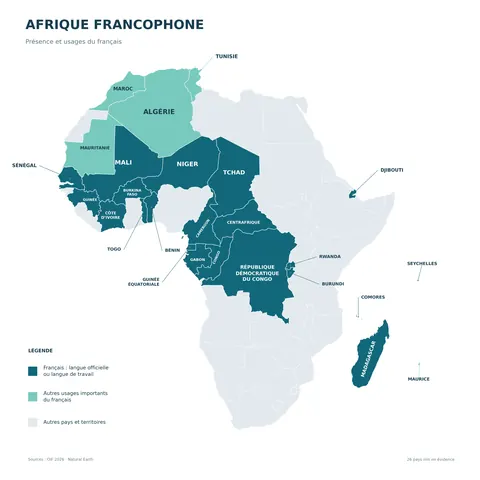
Spanish, French and Portuguese are the official languages of the country. The most frequently cited indigenous languages are Fang, Bubi, Combe, Bisio and Fadambo, along with Ndowe and pidgin. Fang is the most widespread indigenous language, Bubi is spoken on the island of Bioko and Annobonese on the island of Annobón.
Foreigners and migration in the population of Equatorial Guinea
Foreigners made up 12.4% of residents at the 2015 census. Their share reached 16.5% in Wele-Nzas province, 12.7% in Bioko Norte and 12.3% in Litoral, against 1.7% in Annobón. Movement with Central African neighbours remains a sensitive issue: in April 2025, several Cameroonian nationals were expelled without their embassy being informed, and Yaoundé saw this as a breach of the regional conventions on free movement.
The question of migration took on a new dimension with the arrival, from November 2025, of a first group of migrants expelled from the United States, after the vice-president confirmed in May 2025 that talks on the subject were under way.