French-speaking Africa: the French language, states and shared currencies
French-speaking Africa: definition and scope
French-speaking Africa refers to all the African states where French is an official, co-official or working language, together with countries where it remains very present without official status. It stretches from the Atlantic to the Indian Ocean and includes twenty-one states with official or working-language status, as well as five countries where French keeps a significant place in everyday use.
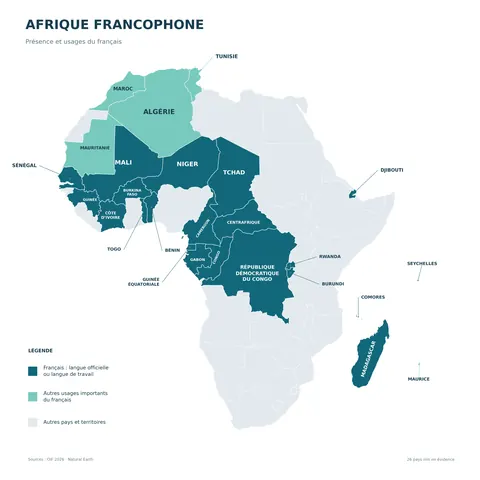
French in Africa: status and speakers
French is most often an official language, either alone or alongside others: with English in Cameroon, with Malagasy in Madagascar, with Arabic in Djibouti, and with Spanish and Portuguese in Equatorial Guinea. Three Sahelian states have changed this status: Mali through its 2023 Constitution, Burkina Faso through the revision of December 2023 and Niger through the charter of 26 March 2025 have made it a working language. All three left the International Organisation of La Francophonie in 2025.
According to the 2026 report of the International Organisation of La Francophonie, French has 396 million speakers worldwide, making it the fourth most widely spoken language, and about 65% of them live in Africa. The rise from the 321 million of 2022 is partly due to a change in counting method.
Two CFA franc zones and the Guinean franc
The West African Monetary Union (WAMU), whose central bank is the BCEAO in Dakar, issues the West African CFA franc, code XOF, for eight states: Benin, Burkina Faso, Ivory Coast (Côte d'Ivoire), Guinea-Bissau, Mali, Niger, Senegal and Togo. The West African Economic and Monetary Union (WAEMU), an economic union, rests on a treaty separate from that of the WAMU, the monetary union.
The Central African Economic and Monetary Community (CEMAC) brings together Cameroon, the Central African Republic, the Republic of the Congo, Gabon, Equatorial Guinea and Chad. Its central bank, the BEAC, issues the Central African CFA franc, code XAF. The XOF and the XAF are two separate currencies, both pegged to the euro at a fixed rate: 655.957 CFA francs to one euro, according to the BCEAO, since the adoption of the euro.
Guinea, a French-speaking country, remains outside these zones with its own currency, the Guinean franc, code GNF. Guinea-Bissau, a member of WAEMU, is Lusophone, with Portuguese as its official language.
Shared organisations: OHADA and CIMA
The Organisation for the Harmonisation of Business Law in Africa (OHADA), created by the Port Louis Treaty of 1993, applies uniform business law in seventeen African states, including the Comoros and the Democratic Republic of the Congo. Its permanent secretariat is based in Yaoundé. The Inter-African Conference on Insurance Markets, or CIMA, provides a common insurance code for several states in the two CFA franc zones.
Demographic and economic weight of French-speaking Africa
According to the International Organisation of La Francophonie, more than 170 million pupils in thirty-six countries were taught in French or learned it at school in 2024.
Economic situations vary widely. Ivory Coast is the world's leading cocoa producer; the Democratic Republic of the Congo mines copper and cobalt; Gabon, the Republic of the Congo and Chad depend heavily on oil; Guinea holds large bauxite reserves.