African Development Bank (AfDB): priorities, financing and projects
What is the African Development Bank
The African Development Bank (AfDB) is a multilateral development finance institution headquartered in Abidjan, Ivory Coast (Côte d'Ivoire). It has 81 member countries, including 54 African and 27 non-African countries, and finances public and private projects on the continent through loans, grants, guarantees and equity investments.
Governance and member countries of the AfDB
The Board of Governors, made up of ministers of finance and economy or central bank governors, is the supreme body of the Group. It elects the president for a five-year term. Sidi Ould Tah of Mauritania was elected ninth president on 29 May 2025, at the Annual Meetings held in Abidjan, and took office on 1 September 2025, succeeding Akinwumi Adesina.
Voting requires a majority of the votes of regional and non-regional countries, which gives shareholders from outside the continent a real role. The Bank's authorised capital stands at 318 billion dollars and it holds the highest credit rating, AAA. A significant share of this capital is callable: it underpins lending capacity without being cash immediately available for projects.
African Development Bank Group and the ADF
The Group comprises the AfDB, which lends on market terms to middle-income countries and the private sector, the African Development Fund (ADF), the concessional window for low-income countries, and the Nigeria Trust Fund. In December 2025 the ADF raised a record 11 billion dollars for 2026-2028 for the benefit of 37 countries.
The ten-year strategy for 2024-2033 guides the Bank's action. Under the presidency of Sidi Ould Tah, it adopted a new African financial architecture in April 2026, formalised by the eleven-point Abidjan Consensus, which covers project preparation, the mobilisation of domestic savings, risk sharing and donor coordination.
Priorities and projects financed by the African Development Bank
Financing is concentrated on infrastructure, energy, agriculture, industrialisation, regional integration and human capital. Among recent operations, a 200 million dollar loan under the BRIDGE programme supports the roll-out of open-access fibre optic cable in Nigeria. In Morocco, a loan of 100 million euros backs a lithium-ion battery factory. In Ghana, a grant of 71.55 million dollars finances the training of 28,000 people.
The Bank is also strengthening its guarantee tools. On 22 May 2026 the board approved an equity stake of up to 125 million dollars in the risk insurer ATIDI, to increase its guarantee capacity, and it supports project development funds for green infrastructure.
The AfDB's place in French-speaking Africa
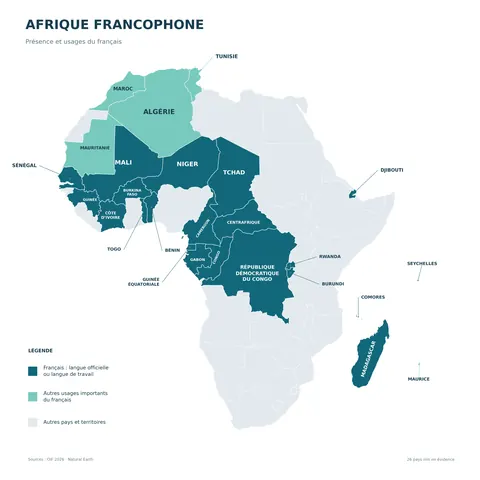
French-speaking countries in West and Central Africa, from Ivory Coast to Cameroon, are both shareholders in and beneficiaries of the Bank. It operates alongside regional banks such as the West African Development Bank (BOAD) and the Development Bank of Central African States (BDEAC).