Population of Mali: demographics, major cities and languages spoken
What is the population of Mali?
The population of Mali stands at 22,395,489 inhabitants at the fifth general census of population and housing, carried out in 2022 by the National Institute of Statistics. It is very young, mostly rural and concentrated in the south of the country, across a territory of 1,240,000 square kilometres whose north remains sparsely populated.
A young and dynamic demography
Between the 2009 and 2022 censuses, the number of inhabitants grew by an average of 3.3% a year, against 3.6% between 1998 and 2009. The median age is 16.1 years in 2022. Children under fifteen account for 47.2% of inhabitants, more than ten million children.
Women make up 49.7% of the total. The International Monetary Fund estimates the population at 24.8 million people in 2025, which extends the trend observed at the census. This age structure weighs on the need for schools, health centres and jobs.
Bamako and the regions: an uneven distribution
The district of Bamako has 4,227,569 inhabitants in 2022, or 18.9% of the total. Next come the regions of Ségou with 2,455,263 inhabitants, Koulikoro with 2,255,157, Kayes with 1,840,329 and Sikasso with 1,533,123. The country is now divided into nineteen regions and a capital district.
At the census, 30.4% of Malians live in urban areas and 69.6% in rural areas. The northern regions, such as Gao, Timbuktu, Ménaka, Taoudenni and Kidal, have much smaller populations: Kidal does not exceed 83,192 inhabitants and Taoudenni 100,358. The regional capitals, such as Sikasso, Ségou, Mopti, Kayes, Gao and Timbuktu, structure the urban network around the capital.
Languages and religion of Malians
Bambara is the mother tongue of 49.9% of inhabitants aged three and over. It is followed by Fulfulde or Fula with 8.19%, Malinké with 7.11%, Soninké with 6.53% and Dogon with 5.43%. Songhai, Minianka, Tamasheq and Senufo complete a landscape of more than ten national languages.
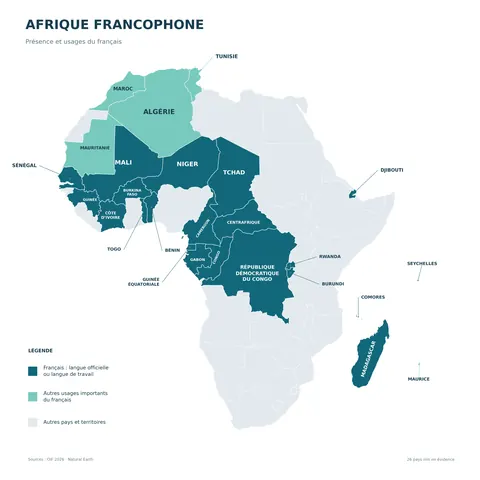
As the main language of communication, Bambara reaches 57.83% of the people recorded, which makes it the lingua franca of the country. The 2023 Constitution gives the national languages the status of official languages and keeps French as the working language.
In religious terms, 96.45% of inhabitants are Muslim, 2.27% Christian and 0.65% animist. The largest ethnic groups are the Bambara with 35.93%, the Fula with 12.83%, the Malinké with 8.42%, the Soninké with 8.17% and the Dogon with 6.09%.
Migration and mobility
The foreign population living in Mali stands at 94,691 people at the 2022 census, or 0.4% of the total. The same census counts 76,245 people displaced by insecurity or conflict, mainly in the centre and the north.
Mobility is long-standing: seasonal migration to neighbouring countries, young rural people leaving for Bamako, and labour emigration to West Africa and Europe. These flows feed remittances from the diaspora, which support many households.