Population of Burkina Faso: demography, cities and migration
The population of Burkina Faso at a glance
The population of Burkina Faso refers to all the inhabitants of a landlocked Sahelian country in West Africa. The fifth general census of population and housing, carried out in 2019 by the National Institute of Statistics and Demography (INSD), counted 20,505,155 inhabitants, a young, mostly rural and fast-growing people.
Growth and age structure
According to the INSD, the population grew by 2.94% a year on average between the 2006 and 2019 censuses. This rapid rise is explained by fertility that is still high, even though the total fertility rate fell from 7.2 children per woman in 1985 to 5.4 in 2019.
The age pyramid remains very wide at the base. The 2019 census puts 45.3% of inhabitants in the under-15 age group and 32.6% in the 15 to 34 group, which means nearly eight inhabitants in ten are under 35. This youthfulness weighs on needs for schools, health care and jobs, and it shapes the structure of the country.
Cities, countryside and urbanisation
In 2019, about a quarter of Burkinabè, or 5,360,112 people, lived in urban areas, against 15,145,043 in rural areas. The country therefore remains primarily agricultural, with settlement scattered across villages, even though rural exodus feeds the growth of urban centres.
Ouagadougou, the political capital, had 2,415,266 inhabitants in the commune according to the 2019 census, or 11.78% of the national population and 45.1% of that of all the country's towns and cities. Bobo-Dioulasso, the second city and economic capital of the west, had 984,603.
Languages spoken in Burkina Faso
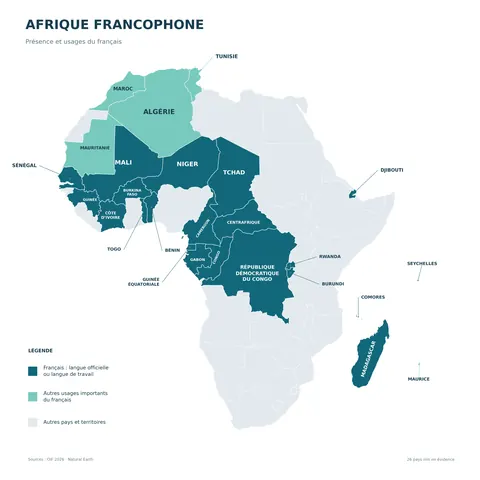
The Burkinabè population speaks many national languages, among which Mooré, Dioula and Fulfulde are very widespread. The constitutional law promulgated on 22 January 2024 raised the national languages to the rank of official languages. French and English are now working languages.
This reform changes the legal status of French, which nevertheless remains widely used in administration, education and the print press. Multilingualism is the rule: one person often speaks a village language, a lingua franca such as Dioula or Mooré, and then French at school or at work.
Migration and internal displacement
The 2019 census devotes an entire chapter to internal and international migration, with tables on immigrants, emigrants and countries of destination. Movements towards neighbouring countries on the Gulf of Guinea, notably Ivory Coast (Côte d'Ivoire), have long been a major feature of Burkinabè demography.
For several years, insecurity in the north and east of the territory has caused forced displacement. The World Bank reports 2.01 million internally displaced people as of 30 March 2023, and 1.4 million returns in September 2026 according to government figures. These movements alter the distribution of inhabitants between regions and swell the outskirts of host towns.