The politics of Ivory Coast: government, elections and diplomacy
The politics of Ivory Coast: a presidential system
The politics of Ivory Coast (Côte d'Ivoire) is organised around a presidential system based on the Constitution of 8 November 2016, which opened the Third Republic. The President of the Republic, elected by direct universal suffrage, leads the executive with a Prime Minister and a government. Legislative power is exercised by Parliament, made up of the National Assembly and the Senate.
Institutions and powers
Parliament comprises the National Assembly, which has 255 seats, and the Senate, created by the 2016 Constitution. The Senate has 99 members: 66 elected by indirect universal suffrage and 33 appointed by decree of the President of the Republic. The Constitution also established a Vice-President, appointed by the head of state.
The Constitutional Council reviews the constitutionality of laws and proclaims the final results of presidential elections. The National Assembly sits in Abidjan, in the Plateau district, and cooperates with the ECOWAS Parliament, the Parliamentary Assembly of the Francophonie and the Inter-Parliamentary Union. Yamoussoukro remains the political capital.
Latest elections in the politics of Ivory Coast
The presidential election of 25 October 2025 pitted five candidates against each other. Alassane Ouattara was proclaimed the winner with 89.77% of the vote, or 3,759,030 votes, on a turnout of 50.10%. The Constitutional Council confirmed this result on 4 November 2025, opening a fourth term for the head of state.
The legislative elections of 27 December 2025 covered the 255 seats of the National Assembly. According to the provisional results proclaimed on 29 December by the Independent Electoral Commission, the RHDP, the party in power, won a very large majority of seats, ahead of the PDCI-RDA and independent candidates, on a turnout of 35.04% of the 8,597,092 registered voters. The Constitutional Council subsequently annulled the vote in two constituencies, Toumodi and Dualla-Massala, where voting was held again on 21 February 2026.
Government and recent institutional life
After these legislative elections, several ministers having been elected as deputies, the government came to an end by decrees of 7 January 2026. Robert Beugré Mambé was then reappointed Prime Minister, and a government of 34 members, including four delegate ministers, was formed by decree of 23 January 2026.
On 10 November 2026, the National Assembly was examining the 2027 budget in committee. It also authorised the ratification of agreements with the Millennium Challenge Corporation for a regional energy programme.
Diplomacy and regional memberships
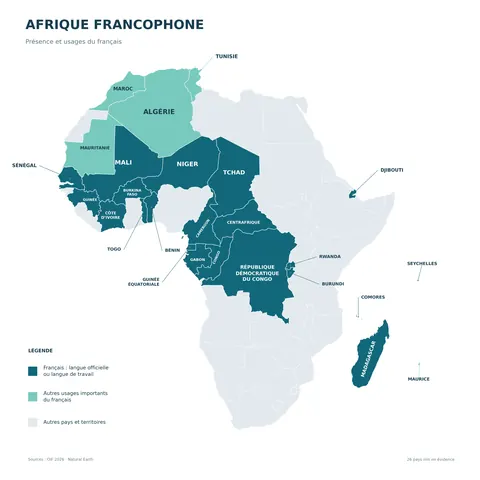
On the diplomatic front, Ivory Coast is a member of the United Nations, the African Union, the International Organisation of La Francophonie, the Economic Community of West African States (ECOWAS) and the West African Economic and Monetary Union.
These memberships place the country within the regional integration frameworks of West Africa. It shares the CFA franc there with the other states of the monetary union, and the National Assembly maintains institutional cooperation with the ECOWAS Parliament, which brings together elected representatives from the sub-region.