CFA franc (XOF): the currency of the eight WAMU states issued by the BCEAO
CFA franc (XOF): definition of the West African currency
The CFA franc (XOF) is the common currency of the eight states of the West African Monetary Union (WAMU). The Central Bank of West African States (BCEAO), an international public institution headquartered in Dakar, Senegal, holds the exclusive right to issue it. Created in 1945, its official name is the franc of the African Financial Community, and its international code is XOF.
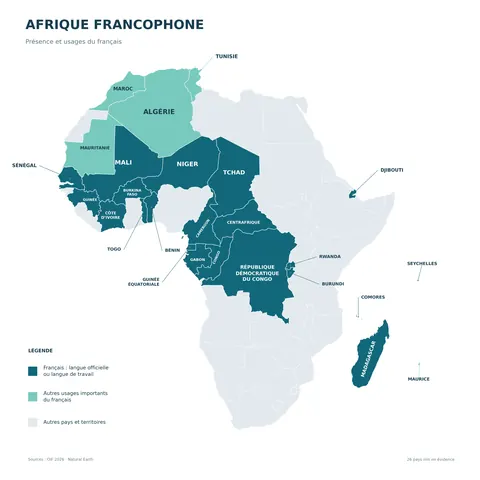
The eight member countries
Benin, Burkina Faso, Ivory Coast (Côte d'Ivoire), Guinea-Bissau, Mali, Niger, Senegal and Togo make up the WAMU. When the BCEAO was created on 12 May 1962, it covered Ivory Coast, Dahomey (now Benin), Upper Volta (now Burkina Faso), Mali, Niger, Mauritania, Senegal and Togo. Guinea-Bissau, whose official language is Portuguese, is now part of the union.
Mali, Burkina Faso and Niger left ECOWAS in January 2025, but they remain among the WAMU states and use the XOF. The WAMU and the West African Economic and Monetary Union (WAEMU) rest on two separate treaties: the first governs the currency, the second the economic union.
Issuance and operation of the BCEAO
The BCEAO issues the banknotes and coins that are legal tender throughout the union. The creation, issuance and cancellation of the currency are decided by the WAMU Council of Ministers. The bank conducts monetary policy, aiming for price stability while supporting growth, sets banking regulation and supervises banks through the Banking Commission, for which it provides the general secretariat. It also assists the states in their international financial relations, acting as financial agent with the International Monetary Fund.
The Governor of the BCEAO is Jean-Claude Kassi Brou. The bank's bodies are the Governor, the Monetary Policy Committee, the Board of Directors, the Audit Committee and the National Credit Councils. The WAMU has the Conference of Heads of State and Government, the Council of Ministers, the Banking Commission and the Regional Council for Public Savings and Financial Markets.
Peg to the euro and convertibility of the CFA franc (XOF)
The XOF is pegged to the euro at a fixed parity: the BCEAO exchange rate table for 12 November 2026 shows 655.957 CFA francs to one euro, both buying and selling. Since the reform of 2019-2020, the BCEAO no longer centralises its foreign exchange reserves at the French Treasury and France no longer sits on its governing bodies, but the fixed parity and France's convertibility guarantee are maintained.
The XOF is distinct from the Central African CFA franc (XAF), issued by another central bank for another monetary union. Their central banks cooperate: the Governor of the BCEAO and the Governor of the Bank of Central African States (BEAC) held a bilateral meeting in Dakar on 6 May 2026, under a cooperation agreement signed on 18 November 2008. Their 2025-2026 action plan covers digital transformation, financial inclusion, cybersecurity and the interconnection of payment systems.
The ECOWAS single currency project
ECOWAS is preparing a single currency, the eco, based on convergence criteria covering inflation, debt and the deficit. Announced in 2019 to replace the XOF, the eco has not come into force: the XOF remains the currency of the WAMU.