Population of Guinea-Bissau: its cities, languages and migration
Population of Guinea-Bissau: definition and order of magnitude
The population of Guinea-Bissau numbers about 2.3 million in 2025, according to the United Nations Population Fund. It is spread between the capital Bissau, smaller towns in the interior, the Bijagós archipelago and a majority of rural villages on the Atlantic coast and in the east of the country.
A young, rural and very diverse society
The country is one of the smallest in West Africa by area, yet it brings together a mosaic of ethnic groups. The Balanta, Fula, Mandinka, Manjak and Papel are among the largest communities, each with its own language, activities and areas of settlement.
The age structure is still marked by a high proportion of children and young people, which weighs on the need for schools, maternal health care and jobs. The programmes of the United Nations Population Fund focus on assisted deliveries and family planning.
Bissau and the towns of the interior
Bissau, on the Geba estuary, is the political, administrative and economic capital. Its port, markets and administrations attract people from the regions, so the city holds a large share of the country's urban population and has a status of its own, that of an autonomous sector.
The rest of the territory is organised into eight regions. Bafatá and Gabú anchor the east, Bissorã and Mansôa the centre-north, Cacheu and Canchungo the northern coast, Buba and Catió the south. Bolama, the first colonial capital, and the islands of the Bijagós archipelago, a UNESCO biosphere reserve, remain thinly populated and difficult to reach.
Languages spoken in Guinea-Bissau
Portuguese is the official language, inherited from the colonial period, and it is used in administration, education and the media, but only a minority speak it in daily life. Kriol, a creole with a Portuguese-based vocabulary, serves as the lingua franca between groups and is heard in markets, schools and public debates.
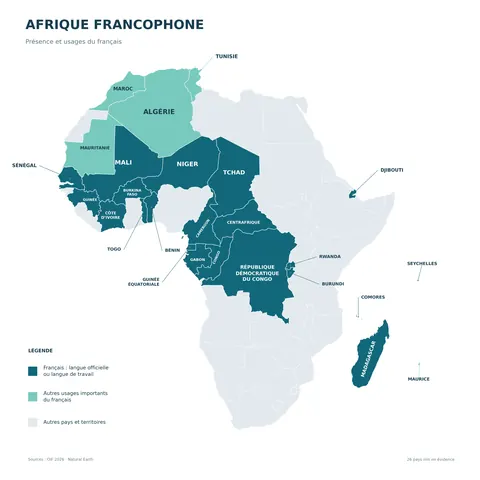
National languages such as Balanta, Fula, Mandinka, Manjak and Papel remain the languages of the home. French is taught and used in exchanges with the French-speaking neighbours, Senegal and Guinea, but it has no official status. Guinea-Bissau belongs to the Community of Portuguese-Speaking Countries.
Migration and the census
Population movements go first towards neighbouring countries. Senegal, notably Casamance, as well as The Gambia and Guinea, host Bissau-Guineans and families linked on both sides of porous borders. Portugal, France and Spain are the main destinations of the diaspora outside Africa.
Internal movements from the countryside to Bissau feed urban growth, while the free movement provided for within the ECOWAS area eases travel to countries of the region.
The fourth general population and housing census, conducted by the National Institute of Statistics with the support of the United Nations, began on 1 June 2026 across the whole territory, with an extension of five days. Its results will set the numbers by region, by age and by language.