OHADA: the Organisation for the Harmonisation of Business Law in Africa
What is OHADA, the business law organisation
OHADA (Organisation for the Harmonisation of Business Law in Africa) is an international organisation created by the Treaty of Port Louis, signed on 17 October 1993 in Mauritius. It brings together 17 African states that apply a common business law, drawn up through uniform acts and interpreted by a single regional court.
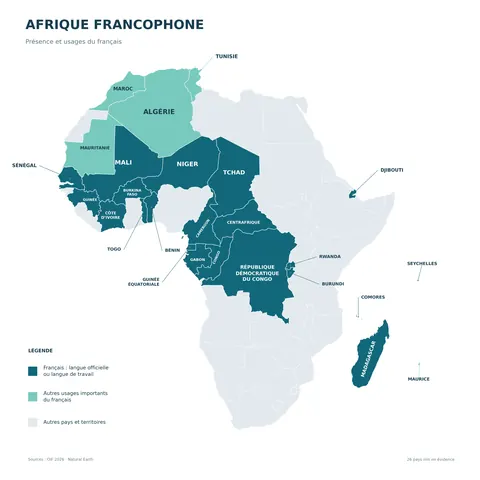
Creation, treaty revision and member states
The Treaty of Port Louis was revised in Quebec on 17 October 2008, which clarified how the institutions work. The organisation has 17 member states: Benin, Burkina Faso, Cameroon, the Central African Republic, Ivory Coast (Côte d'Ivoire), the Republic of the Congo, the Comoros, Gabon, Guinea, Guinea-Bissau, Equatorial Guinea, Mali, Niger, the Democratic Republic of the Congo, Senegal, Chad and Togo.
These countries belong to several regional groupings, mostly French-speaking, together with Portuguese-speaking Guinea-Bissau and Spanish-speaking Equatorial Guinea. Membership of OHADA rests on a business law treaty that is separate from those of the monetary unions.
Uniform acts: the common law of OHADA
The uniform acts are the core of the system. The Council of Ministers adopts them, and they then enter into force in each member state without national transposition. They apply directly and take precedence over conflicting provisions of domestic law.
Eleven uniform acts now cover general commercial law, commercial companies and economic interest groupings, security interests, debt recovery and enforcement procedures, collective proceedings, arbitration, mediation, business accounting, accounting for non-profit entities, carriage of goods by road and cooperative societies. The uniform act on debt recovery and enforcement was revised in October 2023.
OHADA institutions: Council, Common Court and Secretariat
The treaty provides for five bodies. The Conference of Heads of State and Government sets political direction. The Council of Ministers adopts the uniform acts. The Permanent Secretariat, based in Yaoundé, Cameroon, prepares draft texts and monitors their application.
The Common Court of Justice and Arbitration (CCJA) sits in Abidjan and has 13 judges. It is the court of cassation for uniform law, which prevents divergent interpretations between national courts, and it issues advisory opinions. It also administers arbitrations conducted under its rules. The Regional Higher School of Magistracy (ERSUMA) trains magistrates, lawyers and other professionals in uniform law.
Objectives and effects for businesses
OHADA pursues an objective of legal and judicial certainty. An identical rule on the trade register, security interests or collective proceedings reduces uncertainty for the entrepreneur, the creditor and the foreign investor, who finds the same principles from one state to another.
The organisation does not, however, legislate on criminal law, labour law or taxation, which remain a matter for national legislation.