Interview on French-speaking Africa: African finance as seen by Nabil Frik
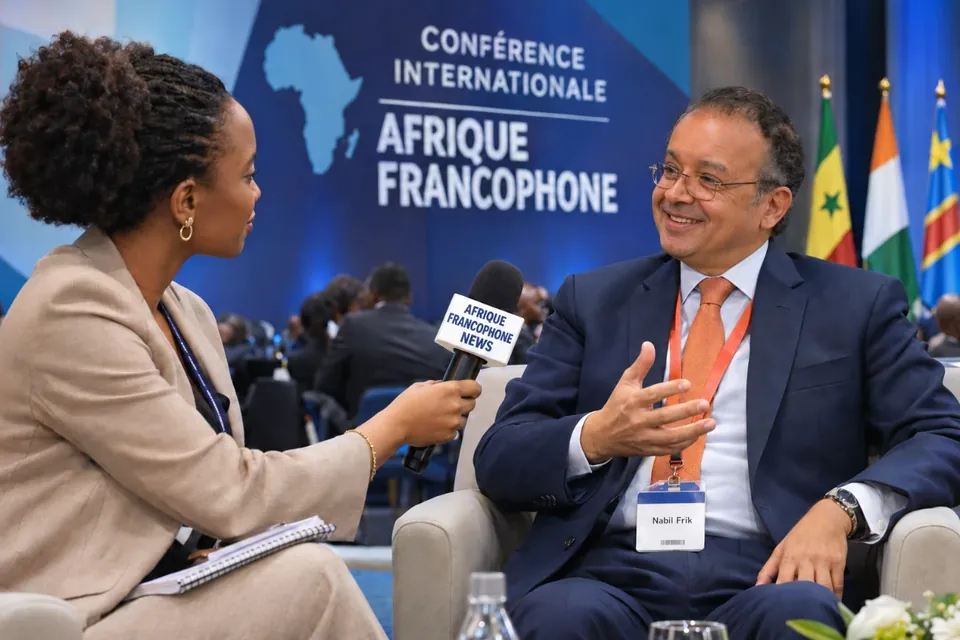
Interview on French-speaking Africa: banks, the CFA franc and trade finance
The interview on French-speaking Africa between Nabil Frik and Afrique Francophone News, dated 11 November 2026, covers five themes: the future of banks and insurers, the CFA franc, trade finance, the informal sector and the role of North Africa.
Afrique Francophone News – Interview of 11 November 2026
An expert in finance in Africa and the Middle East, Nabil Frik has more than twenty-five years of experience in international banking. A former Managing Director and Head of Financial Institutions for Africa, the Middle East and Asia at British Arab Commercial Bank in London, he has also worked at Qatar National Bank, Europe Arab Bank, ING Barings and Siemens Financial Services.
His career combines bank management, international trade finance, project finance and support for relationships between African banks and international partners. His experience of London and Frankfurt, his knowledge of African markets and his command of French, English, German and Arabic give him a cross-cutting view of transactions and of the expectations of the various parties involved.
In this imaginary interview with Afrique Francophone News, he sets out a vision of African finance founded on trust, productive transformation and the ability of businesses and banks alike to present bankable transactions.
1. The future of banks and insurers in Africa
Afrique Francophone News: How do you see the future of finance in Africa, particularly that of banks and insurance companies?
Nabil Frik: I see a promising future, provided that financial development translates into services that are genuinely useful to households and businesses. My criterion would be the ability to finance a productive activity, to secure a family's income and to support a business as it grows. This development has to be assessed country by country: African markets differ greatly in their size, their institutions, their resources and their needs.
Mobile payments have already widened access to financial services. According to the Global Findex 2025 data, based on the year 2024, around 40% of adults in sub-Saharan Africa have a mobile money account. This progress opens up possibilities, but access to a means of payment is not enough to guarantee access to suitable credit or effective insurance.
For banks, I would favour a model that combines closeness to customers with a better analysis of their cash flows. An agricultural SME, a haulier or a manufacturer must be able to obtain financing whose tenor matches their operating cycle. Partnerships with fintechs can simplify payments, the collection of documents and the monitoring of receipts. The credit decision must nevertheless remain understandable, with transparent costs and effective data protection.
Insurance deserves a much greater place in this transformation. I am thinking of health, agricultural risks, the transport of goods, equipment and business interruption. A business exposed to a major loss can hardly invest on a lasting basis. To strengthen trust, insurers will have to offer cover that is easy to understand and demonstrate their ability to pay claims. A product sold easily by phone loses its value if the customer discovers its exclusions too late or struggles to obtain a settlement.
Finally, I would like to see more long-term savings contribute to the financing of the economy, in keeping with the commitments of insurers and institutional investors. This requires sound projects, appropriate instruments and credible supervision. The quality of governance, the training of teams and the trust of customers will determine the reach of this growth. Technology can accelerate change; institutions must make it lasting.
2. The role of the CFA franc and its future
Afrique Francophone News: What role does the CFA franc play today, and what development do you consider desirable for the economies that use it?
Nabil Frik: We must begin by clarifying what we are talking about. The CFA franc covers two distinct currencies: the XOF, issued by the BCEAO for eight West African states, and the XAF, issued by the BEAC for six Central African states. They share a fixed parity with the euro, currently 655.957 CFA francs to one euro, but belong to different unions and institutions.
In my view, the main contribution of this framework is monetary predictability. A business can organise certain payments and investments more easily when it knows the relationship between its currency and the euro. Within the same union, the common currency also facilitates transactions. This stability remains valuable for savings and contracts. It does not, however, remove commercial risk, sovereign risk or the difficulties a bank may encounter in financing a transaction.
The debate on the future of the CFA also concerns sovereignty, the legitimacy of decisions and the ability of monetary policy to meet the needs of the economies. A fixed exchange rate regime limits certain possibilities for adjustment. The countries concerned may legitimately examine whether the current arrangements sufficiently serve their industrialisation, their competitiveness and their regional integration. These questions deserve an informed discussion involving citizens, businesses and institutions.
Account must also be taken of the changes that have already occurred. The reform launched in 2019 in West Africa altered monetary cooperation, notably with the closure of the BCEAO's operations account with the French Treasury and the change in governance. The parity with the euro and the French guarantee of convertibility were maintained. These changes must not be automatically attributed to Central Africa.
As regards the ECO, ECOWAS was still maintaining in September 2026 a target of launching it in 2027, while reporting conditions and work still to be completed. This is an institutional target, the achievement of which remains to be confirmed. It would be premature to infer from it a certain and simultaneous disappearance of the two CFA francs.
My position would be to judge any monetary change by its effects on populations and businesses. A credible transition requires sound governance, reserves, economic coordination and the preparation of banks and contracts. The protection of savings must remain central. Monetary sovereignty is also consolidated through the ability to produce, to export and to mobilise sustainable revenues. The choice belongs to the countries concerned; its success will depend on the quality of its preparation.
3. Trade finance and small African banks
Afrique Francophone News: How can trade finance be developed in Africa, and how can small African banks obtain the funding they need to support their customers in international markets?
Nabil Frik: These two subjects are closely linked. Trade finance, or the financing of trade, makes it possible to manage the gap between an order, production, shipment and payment. An exporter may have a serious buyer and lack the cash to prepare its delivery. An importer may have a market but not have the liquidity or the guarantees expected by its supplier.
The scale of the need remains considerable. In its report presented in 2026, the African Development Bank estimates unmet demand for trade finance at between 74 and 92 billion dollars for 2024. It also highlights the weight of foreign currency liquidity constraints. This shows that financing depends both on the quality of the transaction and on the ability of banks to mobilise the necessary resources.
My starting point would always be the real transaction: identifying the buyer, verifying the contract, understanding the movement of the goods and establishing the source of repayment. A consistent instrument must then be chosen: documentary credit, guarantee, pre-export finance or receivables finance. A poorly drafted contract, unworkable documentation or a maturity incompatible with the commercial cycle can prevent the financing of a transaction that is nonetheless attractive.
For a small African bank, international access has three dimensions that must be distinguished. A correspondent relationship makes it possible, in particular, to make payments. A confirmation line allows a partner bank to add its undertaking to a documentary credit. A funding line provides liquidity, for example in dollars or euros. Having a correspondent therefore does not automatically give access to the other two capabilities.
The size of a bank is not enough to determine its quality. To become a credible counterparty, it must make its position transparent: shareholding, audited accounts, capital, asset quality, credit concentrations, liquidity and governance. Its know-your-customer, anti-money laundering and transaction monitoring controls must work in day-to-day operations. The international partner must be able to understand the risks it is taking and obtain reliable answers. An analysis proportionate to the risk remains essential.
I would recommend starting with a limited portfolio of well-documented transactions, with controlled amounts and maturities. A track record of regular repayments, transparent communication and sound handling of incidents can then allow the relationship to be broadened. It is in a small bank's interest to demonstrate its precise knowledge of its customers and of its sectors.
Development institutions can support this process. The IFC's GTFP programme offers, in particular, transaction-specific guarantees covering the payment risk of issuing banks towards confirming banks. These mechanisms can facilitate relationships that would otherwise be difficult to establish. They remain subject to analysis and to eligibility conditions.
For me, the bankability of a bank rests on its ability to present measurable risks and to honour its commitments. The aim would be to enable it to support its customers abroad on a lasting basis, while protecting its balance sheet against excessive dependence on short-term foreign currency funding.
4. The bankability of informal sector businesses
Afrique Francophone News: How can informal sector businesses, which often have a real activity but remain remote from bank financing, be made bankable?
Nabil Frik: Their economic activity must be recognised and the means of assessing it must be built. A trader, a workshop or a small processor may have regular customers, a margin and long experience, while not having the documents that a bank usually expects. The challenge is to turn this knowledge on the ground into verifiable information.
The first step is to understand the flows: sales, purchases, expenses, seasonality and cash requirements. Supplier invoices, account statements, digital receipts or contracts with regular customers can contribute to this analysis. The IFC rightly emphasises the value of digital channels, data analysis and partnerships in improving the financing of small businesses faced with a lack of collateral or financial history.
The quality of this information must nevertheless be assessed. Large movements of money do not, on their own, prove the profitability of a business. Some receipts may correspond to advances, family transfers or sums that do not belong to it economically. The bank must reconstruct a margin and a cash flow available for repayment, taking personal expenses into account where the finances of the household and of the business are still mixed.
I would propose a gradual path: identifying the entrepreneur and the beneficial owners, meeting the applicable obligations, separating the business account from the personal account as far as possible, and then introducing simplified bookkeeping. Formalisation must give access to concrete benefits, such as outlets, better secured payments and suitable financing. It will be more credible if the procedures remain understandable and proportionate.
Credit could then begin on a reasonable scale, for a clearly identified need. Let us take a hypothetical example: a small food processor receives regular orders from a distributor. If the orders, costs, deliveries and payments can be verified, the bank can consider financing a production cycle. Repayment would be organised from the proceeds of that cycle, with appropriate security and agreed monitoring.
Cooperatives, structured buyers and professional organisations can help to document activities and prepare applications. Partial guarantees can also facilitate certain financings, but they are no substitute for economic viability. I would favour a relationship in which the amount of credit increases with the quality of the information and the repayment history.
Finally, the use of digital data requires appropriate consent, the protection of that data and explainable decisions. An entrepreneur must be able to understand a refusal and correct inaccurate information. Bankability should become an accessible progression: organising one's activity better, making one's income visible and gradually demonstrating one's ability to repay.
5. North Africa and the African market
Afrique Francophone News: What role can North Africa play in building a more integrated African market with the French-speaking countries of sub-Saharan Africa?
Nabil Frik: I see significant potential in partnerships in production, financing and training. The ambition should be to create more value in both regions. This requires joint investments, a movement of skills and commercial relationships in which each party has outlets and clearly defined responsibilities.
The African Continental Free Trade Area provides a framework for this ambition. It aims at a continental market for goods and services, with gradual liberalisation. Its existence does not mean that economic borders, regulatory constraints or logistical obstacles have already disappeared. Implementation matters as much as the agreement itself.
In practical terms, I would favour projects linking industry, agriculture, logistics and financial services. Let us imagine a partnership between an equipment manufacturer from North Africa and an agri-food processing company in Côte d'Ivoire or Senegal. The project could combine the installation of a production unit, the training of teams, maintenance and access to several markets. A local bank would finance operations, while equipment finance and suitable insurance would be examined with other partners.
To make such a project bankable, it is necessary to verify demand, transport costs, supply, energy, rules of origin and the possibility of transferring payments. Delays at borders and incompatible standards can absorb a commercial margin. The World Bank, moreover, stresses the need to make customs systems, standards, transport, energy and payments work together in order to develop regional production chains.
North African and sub-Saharan banks could deepen their co-financing, their correspondent relationships and the sharing of certain skills. Insurers and reinsurers could cover transport, construction and operating risks. These partnerships would benefit from strengthening local capacities and from drawing on a sound knowledge of the laws and practices of each country.
Payments are another area of work. PAPSS enables cross-border settlements in local currencies between connected participants, which can facilitate certain African transactions. Its operation nevertheless relies on pre-funding and settlement arrangements. A payment infrastructure therefore does not automatically provide the credit that an exporter or its bank needs.
The French language can facilitate certain relationships between North Africa and French-speaking sub-Saharan Africa. Trust must also be built through enforceable contracts, clear governance and a fair sharing of risks. This cooperation must remain open to the continent's other linguistic regions.
My conviction is that integration will become tangible when more businesses are able to buy, produce, insure their operations and be paid in another African country with predictable timescales and costs. North Africa can contribute strongly to this development, by developing reciprocal partnerships that create jobs, skills and production capacity on the continent.