The politics of Equatorial Guinea: Constitution, powers and diplomacy
The politics of Equatorial Guinea, a presidential system
The politics of Equatorial Guinea is organised around a presidential republic led since 1979 by Teodoro Obiang Nguema Mbasogo. The executive branch comprises the head of state, a vice-president, the Prime Minister and the Council of Ministers, while Parliament is made up of a Senate and a Chamber of Deputies.
Constitution and institutions
The current text stems from the constitutional referendum of 13 November 2011, which created the post of vice-president and provided for a limit of two presidential terms. The new Constitution was promulgated on 16 February 2012. The presidential term lasts seven years.
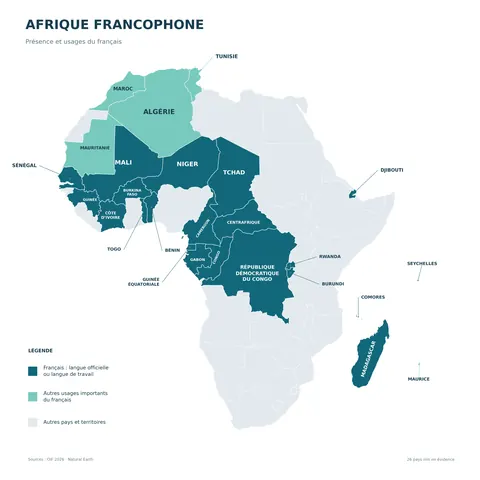
The executive, legislative and judicial powers coexist with the Presidency, the Vice-Presidency, the Council of Ministers, the Senate, the Chamber of Deputies, the Constitutional Court, the Council of the Republic, the Court of Auditors and the Ombudsman. The territory is divided into two regions, eight provinces, nineteen districts and thirty-seven municipalities. Spanish, French and Portuguese are official languages.
Executive and government
The vice-president is Teodoro Nguema Obiang Mangue, son of the head of state. Manuel Osa Nsue Nsua has held the post of Prime Minister since August 2024, following the replacement of Manuela Roka Botey in that post. On 16 June 2026, he handed the president the collective resignation of the government, comprising 36 ministers and secretaries of state, over results judged insufficient. On 20 June 2026, the head of state reappointed him to lead the government.
Elections and parties in Equatorial Guinean politics
Parliament had 70 senators, including 55 elected, and 100 deputies after the 2022 elections. In the presidential, legislative and municipal vote of 20 November 2022, the head of state sought a sixth term. Preliminary results gave more than 99% of the votes counted to the Democratic Party of Equatorial Guinea (PDGE) and its coalition, and the PDGE won all 100 seats in the Chamber of Deputies. Two opposition candidates, Buenaventura Monsuy Asumu and Andrés Esono Ondo, stood.
Capital, diplomacy and regional organisations
On 2 January 2026, Ciudad de la Paz, the chief town of Djibloho province in the east of the country, was proclaimed the new capital. Equatorial Guinea belongs notably to the United Nations, OPEC, the African Development Bank and ECCAS, whose rotating presidency, held by President Obiang, was extended at the Sipopo summit in June 2025. It joined OHADA in 1999.
On 19 May 2025, the International Court of Justice recognised Equatorial Guinea's sovereignty over the islets of Mbanié, Cocotiers and Conga, disputed with Gabon since the early 1970s. On 28 July 2026, the two states concluded in Addis Ababa, under the auspices of the African Union, an agreement establishing a joint consultation and mediation mechanism, without reopening the question of sovereignty.