Population of Senegal, a young and urban demographic profile
Population of Senegal: size and age structure
The population of Senegal totals 18,126,390 inhabitants according to the fifth general census of population and housing, carried out in 2023 by the National Agency for Statistics and Demography (ANSD). It is very young, increasingly urban and concentrated in the west of the country, around Dakar, Thiès and Diourbel.
The median age is 19 and 39.1% of inhabitants are under 15, according to the ANSD. The intercensal growth rate reaches 2.94% between 2013 and 2023, and three in four inhabitants are under 35.
Geographical distribution and major cities
Average density is 92 inhabitants per square kilometre, but it ranges from 15 in the Kédougou region, in the south-east, to 7,485 in the Dakar region, according to the ANSD. The regions of Dakar, Thiès and Diourbel alone account for about 45% of the national population.
The capital, Dakar, forms with Pikine, Guédiawaye and Rufisque an urban area that concentrates administrations, the port, industries and services. The preliminary census report ranks the department of Mbacké, home to the holy city of Touba, first among the most populous departments, ahead of Dakar. Thiès, Mbour, Saint-Louis, Kaolack and Ziguinchor complete the network of medium-sized cities.
Urbanisation
In 2023, 54.7% of Senegalese live in urban areas, or 9,922,399 people, against 45.2% at the 2013 census. The country became predominantly urban in ten years, according to the ANSD, with an urban population that now exceeds that of rural areas.
Languages spoken in Senegal
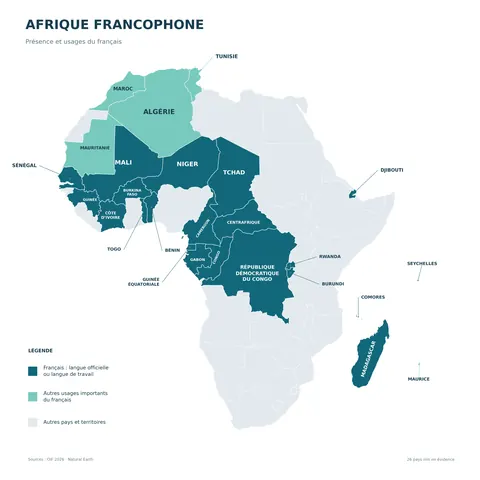
French is the official language. The Constitution also recognises Diola, Malinke, Pulaar, Serer, Soninke and Wolof as national languages, together with any other national language that may be codified. According to the 2023 census, 97.6% of people aged 3 or over use a national language. Wolof is the most widespread, with 53.5% of speakers, followed by Pulaar with 26.3%.
Wolof serves as a lingua franca in cities and markets, including for inhabitants whose mother tongue it is not, while French dominates schools, the courts and official texts.
Internal and international migration of the population of Senegal
Of 17,683,038 residents analysed by the ANSD, 72.8% have never migrated, 25.4% are internal migrants and 1.8% are international migrants. Dakar receives 46.9% of internal migration inflows, with a positive lifetime balance of 778,746 people, while the Louga region shows the sharpest deficit, at 169,502 people.
The census counts 297,386 people born abroad, 58.6% of whom live in Dakar. Among them, 45.2% hold Senegalese nationality and 23.4% Guinean nationality. Over the previous five years, 166,561 people left the country, 83.4% of them men, and work motivates 71.9% of these departures. France, Italy and Spain are the leading destinations, with 34,434, 25,442 and 24,823 emigrants respectively. International net migration is negative, at 110,160 people over five years.