Population of Benin: demographics, cities, languages and migration
The population of Benin: definition and key figures
The population of Benin stands at 14.5 million people in 2024, according to the World Bank. Young and fast-growing, it is concentrated in the south of the country, around Cotonou, Porto-Novo and Abomey-Calavi, while the larger north remains less densely populated. French is the official language, alongside many national languages.
Growth and age structure
According to the United Nations Population Division, the number of inhabitants is rising by about 2.4% a year in 2026, a high rate that stems from still-high fertility. The World Bank reports 5.7 children per woman. The median age stands at 18.2 years in 2026 according to the UN: half of Beninese are therefore younger than that age. Life expectancy reaches 61.2 years in 2024, up 0.5 year on 2023, again according to the World Bank.
This structure weighs on schools, health and employment: every year, many young people enter a labour market dominated by the informal sector.
Cities and urbanisation
The UN estimates that 48.4% of inhabitants lived in cities in 2026, or about 7.3 million people. Porto-Novo is the official capital and hosts the National Assembly and the Senate, while Cotonou, on the coast, is the economic capital and the seat of the presidency and the government. Together with Abomey-Calavi, one of the most populous municipalities in the country, the two cities form an almost continuous urban area along the coastline.
Inland, Parakou, in the Borgou, is the main city of the north and a road junction towards Niger and Nigeria. Bohicon, Djougou and Natitingou in turn anchor the central plateaux and the Atacora.
Languages and groups of the population of Benin
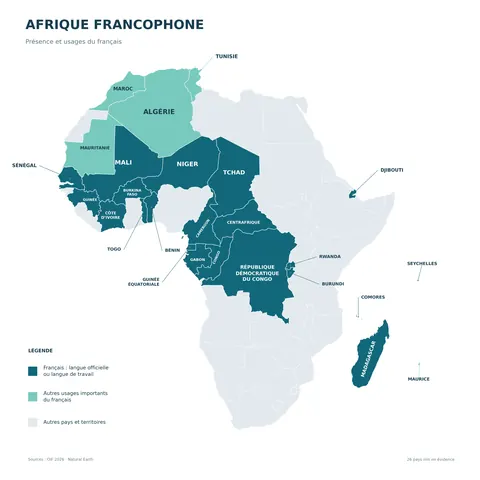
French has been the official language since the 1990 Constitution; it is used in administration, the courts and schools. Some sixty languages are spoken across the territory. Fon is the most widespread and dominates in the south, together with Adja and Goun. Yoruba is spoken mainly in the south-east, on the border with Nigeria, while Bariba and Somba are the major languages of the north.
The largest sociolinguistic groups are the Fon, the Adja, the Yoruba and related peoples, the Bariba, the Fulani, the Ottamari, the Yoa-Lokpa and the Dendi.
Migration and displacement
Benin is a country of departure, transit and reception. In the north, insecurity affecting the Sahel and northern Nigeria has led to arrivals of refugees. At the end of June 2026, the United Nations High Commissioner for Refugees counted about 85,000 forcibly displaced people, including 42,840 refugees and asylum seekers and 42,409 internally displaced people.
The departments of Alibori and Atacora host more than 90% of refugees and asylum seekers. Burkina Faso is the main country of origin, with 27,397 people registered, ahead of Niger and Togo. About 8,400 new refugees arrived in the first half of 2026. Neighbouring Nigeria shares peoples and languages with Benin, notably Yoruba.