Population of Togo: demographics, major cities, languages and migration
Population of Togo: definition and census figures
The population of Togo numbers 8,095,498 inhabitants according to the fifth general population and housing census, carried out by the National Institute of Statistics and Economic and Demographic Studies (INSEED) in October and November 2022. Women account for 51.3% of the total and the density is 143 inhabitants per square kilometre.
Population growth and breakdown by region
Between 2010 and 2022, the population grew by an average of 2.3% a year, a pace that would double it in 31 years according to INSEED. Greater Lomé has 2,188,376 inhabitants, more than a quarter of the national total. Next come the Plateaux region with 1,635,946 inhabitants, the Maritime region outside Greater Lomé with 1,346,615, the Savanes with 1,143,520, the Kara with 985,512 and the Centrale with 795,529.
The country remains mostly rural: 3,473,792 people, or 43%, live in urban areas, compared with 4,621,706 in rural areas.
Major cities and urbanisation
Lomé, the capital on the Gulf of Guinea at the Ghanaian border, dominates the urban network and concentrates the administration, the port and most economic activity. The other hubs are the regional capitals: Tsévié for the Maritime region, Atakpamé for the Plateaux, Sokodé for the Centrale, Kara for the region of the same name and Dapaong for the Savanes.
Kpalimé, in the Plateaux, and Aného, on the coast, are among the best-known medium-sized towns. The pull of Lomé and the regional capitals drives urbanisation, but nearly six Togolese in ten still live outside towns, which keeps demand for basic services high in rural areas.
Languages spoken in Togo
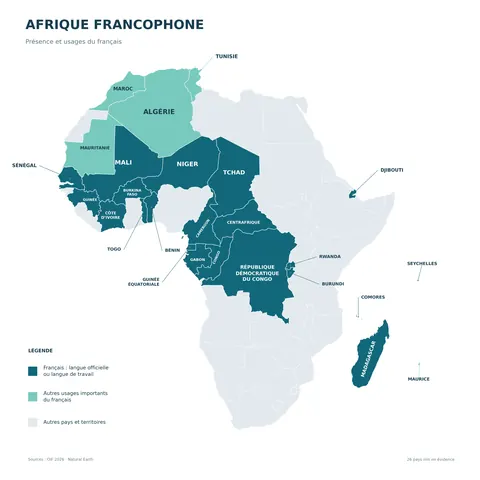
French is the official language and the language of administration and education. The country has several dozen local languages, among them Ewe and Kabiyè, which are recognised as national languages. Ewe dominates in the south, while Kabiyè is the language of the Kara region and its surroundings.
Mina, also called Gen, serves as a lingua franca on the coast, around Lomé and Aného. In the Savanes and the Centrale, other Gur languages such as Moba and Tem are widespread. This mosaic explains why many Togolese speak two or three languages every day.
Migration and mobility of the population of Togo
Togo belongs to ECOWAS, whose protocol on free movement allows nationals of the region to cross borders with a simple identity document for a stay of ninety days. The densest human exchanges are therefore with its neighbours: Ghana to the west, Benin to the east and Burkina Faso to the north.
The road corridor running from the port of Lomé to Ouagadougou, Bamako and Niamey carries drivers, traders and seasonal workers. Within the country, migration mainly takes young rural people to Greater Lomé. A Togolese diaspora is also established in West Africa and Europe.
Each year, about 150,000 people reach working age, while about 90,000 jobs are created, according to the World Bank. The organisation also notes a clear poverty gap between rural areas (58.2%) and towns (26.2%).