CEMAC, the Central African Economic and Monetary Community
CEMAC: definition and member states
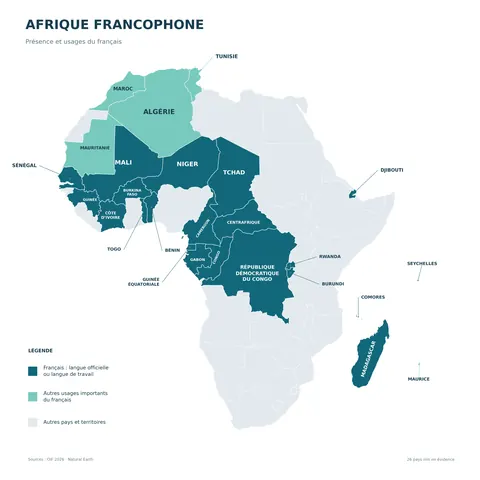
The CEMAC (Central African Economic and Monetary Community) is a regional integration organisation that brings together six states: Cameroon, the Central African Republic, Congo, Gabon, Equatorial Guinea and Chad. Created in 1994 to replace the Central African Customs and Economic Union, it has its headquarters in Bangui and rests on two pillars, an economic union and a monetary union.
Two unions in a single treaty
The founding treaty sets the mission of promoting the balanced development of the member states through two unions: the Economic Union of Central Africa, the UEAC, and the Monetary Union of Central Africa, the UMAC. The states thus undertake to move from simple cooperation to a complete union. The UEAC carries the common economic policies, the UMAC the currency, the Central African CFA franc, code XAF.
The text is drafted in three languages, with the French version authoritative, and any new accession requires the unanimous agreement of the members.
This grouping is distinct from the WAEMU and the WAMU, which rest on other treaties and use the XOF.
CEMAC institutions
The Conference of Heads of State is the supreme body; its chairmanship rotates. Congolese President Denis Sassou N'Guesso holds the chairmanship and chaired the extraordinary summit held in Brazzaville on 22 January 2026.
The treaty also provides for the Council of Ministers, the Ministerial Committee, a Community Parliament and a Community Court of Justice with a judicial chamber and an audit chamber. The Commission, based in Bangui, is the executive of the community; it is chaired by Baltasar Engonga Edjo'o, of Equatorial Guinea, under the principle of rotating posts among the states.
Three specialised institutions complete the system: the Bank of Central African States, the Central African Banking Commission and the Development Bank of Central African States, established in Brazzaville.
Common policies and integration within the CEMAC
The Commission pursues the economic and monetary integration of the sub-region, the pooling of the states' resources for the benefit of all and the delivery of integrating projects. It relies on dialogue with the private sector and on five principles of governance: solidarity, collegiality, equality, transparency and justice.
Common policies include competition law and a community customs code. Economic policy convergence and the free movement of people and goods are among the integration objectives of the community. At the January 2026 summit, the heads of state adopted an action plan to strengthen the stability of the CFA franc and protect purchasing power, notably through the repatriation of export earnings in foreign currency.
Common currency and funding of the Commission
The common currency, the Central African CFA franc, is issued by the BEAC. It is pegged to the euro at 655.957 CFA francs to the euro, and the French Treasury guarantees its convertibility, according to the Banque de France.
The Commission is funded by the community integration levy, paid over by the states. Arrears of this levy reached 263.5 billion CFA francs, an amount announced in Malabo on 16 February 2026. The Central African Republic owed 61.8 billion of it and, at the end of 2025, Cameroon nearly 59.9 billion. On 5 February 2026, the president of the Commission ordered activities deemed non-priority to be put on hold.