Population of Niger: demographics, major cities, languages and migration
What does the population of Niger represent?
The population of Niger stands at about 27.9 million inhabitants in 2025, according to the United Nations Population Fund. Young and fast-growing, it is concentrated in the south of the country, along the border with Nigeria, while the Saharan north remains very sparsely populated.
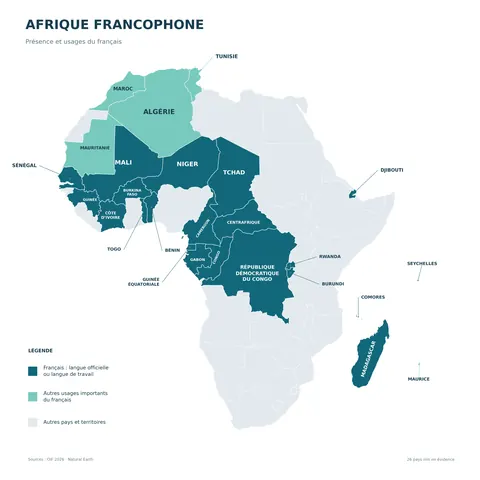
Niger is a landlocked Sahelian country of West Africa. Its territory is vast, but most of its inhabitants live on the southern strip where the rains allow farming and livestock rearing.
Growth and distribution of settlement
The population projections of Niger's National Institute of Statistics use a growth rate of 3.7% for 2023. The national average density stands at 20 inhabitants per square kilometre in that same year, a figure that conceals very large disparities.
The country has eight regions: Agadez, Diffa, Dosso, Maradi, Niamey, Tahoua, Tillabéri and Zinder. Agadez, the largest, opens onto the desert and has few inhabitants, whereas the southern regions, from Dosso to Diffa, hold the great majority of the population. Large families and high fertility fuel this rapid growth, which weighs on schools, health, employment and water resources.
Niamey, Zinder, Maradi: the major cities
Niamey, the capital, stands on the Niger River in the west of the country. The Niamey region had 1,449,801 inhabitants in 2023 according to the National Institute of Statistics projections, with a density of 2,625 inhabitants per square kilometre over an area of about 552 square kilometres. It is by far the leading administrative, economic and university centre.
Zinder and Maradi, in the centre-south, are two major urban and commercial hubs, turned towards neighbouring Nigeria, with which trade in livestock, cereals and goods is constant. Tahoua, Dosso and Tillabéri structure the west and the centre, while Agadez, at the gateway to the Sahara, is a caravan city and a staging post on the northern routes.
Languages spoken in Niger
The country is multilingual. Hausa, the most widespread, is defined as the national language by the Charter of Refoundation, promulgated on 26 March 2025. This Charter lists eleven languages spoken in the territory, among them Zarma-Songhai, Fulfulde, Tamasheq and Kanuri, which correspond to major population groups: Hausa, Zarma-Songhai, Fulani, Tuareg and Kanuri.
French, the official language under the former Constitution, has had the status of working language since this Charter. It is still used in the administration, higher education and part of the press, but daily life takes place in Nigerien languages.
Migration and population displacement
Niger is at once a country of departure, transit and reception. Agadez is a historic crossing point on the routes leading to Libya and Algeria. Seasonal movements of workers and herders towards neighbouring countries are long-standing and frequent, because borders cut across communities that share the same language.
As of 31 August 2026, more than one million people were forcibly displaced in Niger, refugees and internally displaced people combined, according to the World Bank. These displacements are linked to insecurity in some areas of the country and affect families in several regions.